
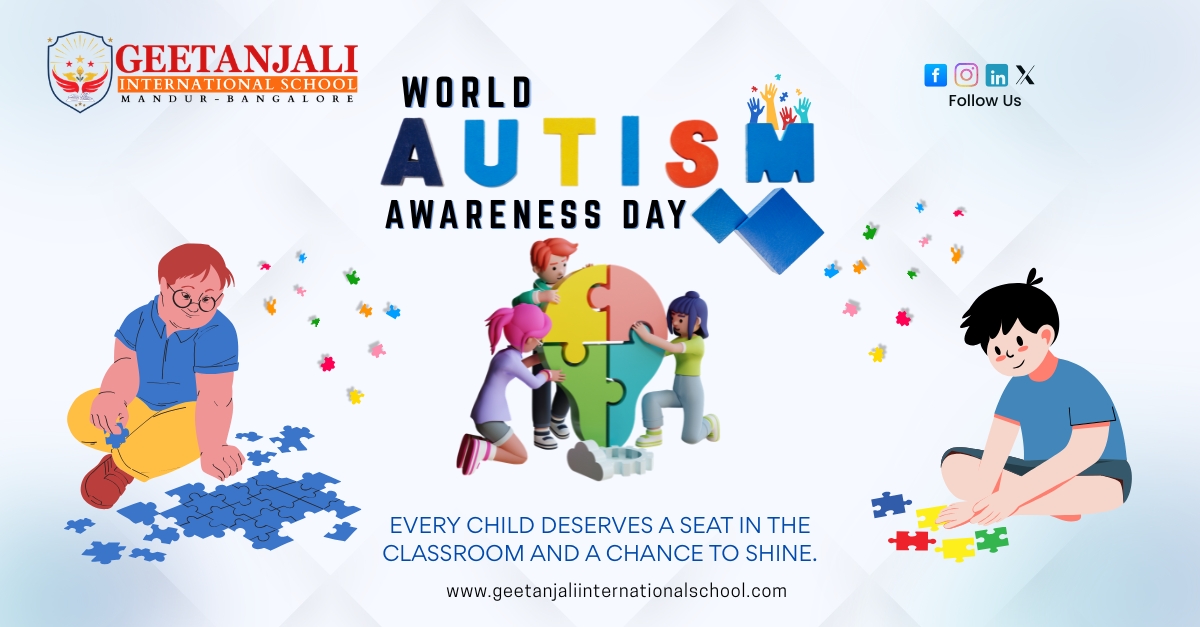
Academic performance today does not define education because students must learn to recognize different cultures and develop empathy and solve practical problems. World Autism Awareness Day, observed on April 2, highlights the importance of acceptance, inclusion, and support for individuals with autism.
At Geetanjali International School, Mandur, Bangalore, which is one of the top international schools in Bangalore, awareness exists throughout the entire year. The school system uses this approach to create an environment which supports students through its daily educational activities.
Understanding Autism Spectrum Disorder (ASD)
Autism Spectrum Disorder (ASD) stands as a developmental disorder which affects both communication abilities and social interaction skills and behavior patterns. Every child with autism demonstrates unique characteristics which include different abilities and different difficulties. The combination of proper support and early understanding and inclusive education enables children with ASD to succeed in both their academic and social lives.
How Education Connects to Real-World Issues
Education today is more than what students read in books. It prepares them to comprehend and respond to the challenges they see in their everyday lives. Understanding autism enables students to recognize the diversity in our society, and how to treat everyone, regardless of their abilities.
Incorporating topics like this into your curriculum, will help the students in the following ways:
- Create empathy and emotional intelligence
- Understand the social issues around the world
- Build an understanding of how to accept and be inclusive
Ultimately, this enables student learning to be about more than simply passing tests, but rather, helps shape students to be responsible citizen of the planet.
Integrating Awareness into School Learning Programs
The Geetanjali International School establishes continuous education as its primary teaching method. The school implements its educational mission through teaching methods which reach all students through their classroom learning activities.
The school provides special programs and student discussions to educate students about autism while teaching them how to include others in their daily relationships.The school provides special programs and student discussions to educate students about autism while teaching them how to include others in their daily relationships.
Experiential Learning and Student Leadership
Experiential learning is essential to understanding autism awareness; therefore, experiential learning provides students with a means to actively participate instead of being passive learners through:
- Role-playing actual situations
- Sensory, art, & music activities
- Awareness & campaign programs initiated by students
Leadership opportunities allow students to take charge, plan & carry out events & lead group discussions. This provides not only an opportunity for self-confidence to grow but also encourages students to have the shared responsibility to provide an inclusive environment.
Nurturing Values and Social-Emotional Growth
Inclusive education promotes the development of key life skills in an atmosphere of respect. Students will develop respect for individual needs as well as:
- Communication and teamwork
- The ability to adapt and thrive in a diversity of settings
- Social responsibility and acts of kindness towards others
These are important traits to assist students with personal development and future success in life.
The Role of Parents in Reinforcing Awareness
When families and schools form a partnership, education is more effective. By encouraging parents to support autistic children through:
- Encouraging open dialogue about acceptance
- Teaching students kindness and patience
- Participating in school-based initiatives and education about autism,
You will create consistency between home and school in communicating an inclusive message.
Building an Inclusive School Culture Beyond the Classroom
The process of creating awareness needs to extend beyond lessons and events because organizations need to establish a daily practice of inclusive behavior. Schools can promote this by developing peer support systems which choose to recognize diversity through their assembly and activity programs while creating an atmosphere of safety and respect for all students.
Students develop these values through their school environment because they learn to practice them within their communities. This process creates a future society which demonstrates greater understanding and respect while people work together as one.
Long-Term Impact on Character and Future Readiness
The knowledge gained through increased understanding about people with autism will extend past the classroom environment. Students learn to become:
- Emotionally responsible and caring
- Able to perform successfully within diverse social contexts
- Prepared to participate in diverse workplaces and create an inclusive work environment.
These characteristics are critical elements of success in higher education, career and life.
FAQs
- What is World Autism Awareness Day?
A day on April 2nd that promotes autism awareness, acceptance, and inclusion. - How do the best CBSE schools in Bangalore promote awareness?
Through inclusive teaching, activities, and student-led programs. - What is ASD?
A developmental condition affecting communication, behavior, and social skills. - Why is inclusive education important?
It builds empathy, respect, and teamwork among students. - What is experiential learning in this context?
Learning through activities like role-play, art, and group work.