
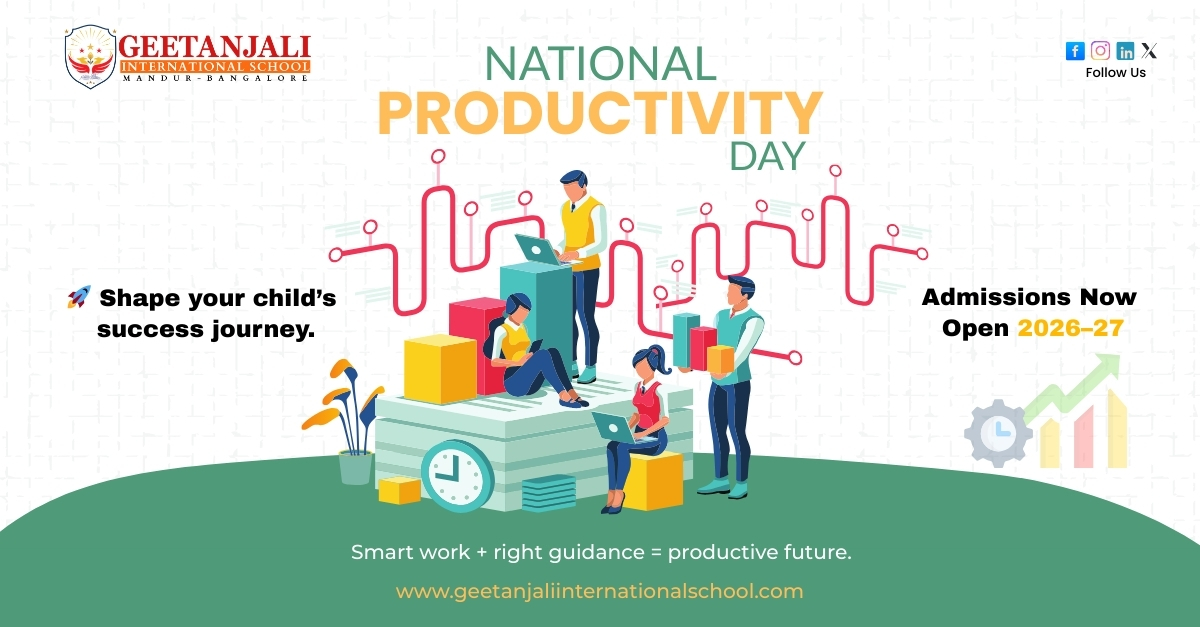
The people of India celebrate National Productivity Day on February 12 to demonstrate how better efficiency and innovative solutions and responsible resource management contribute to national progress. The fast-changing technology-based environment of the present day connects productivity with creativity and problem-solving capabilities and knowledge management skills. Students who learn about productivity during their school years develop vital capabilities that they will need in their future lives. Geetanjali International School in Mandur Bangalore functions as an international educational institution which promotes future-oriented learning practices that help students develop innovative thinking skills and time management abilities while preparing for the demands of an ever-changing worldwide environment.
Why Productivity Matters for Students
The connection between productivity and achievement usually exists after entering the workforce. However, the foundation for achievement or productivity begins at a very young age (i.e., the earlier a child establishes their own productive learning habits the sooner they learn how to create goals, manage time, and complete tasks).
Over time, the productive learning habits that an individual develops will result in the acquisition of many valuable life skills such as:
- Using their Time Wisely (Time Management)
- Finding Focus and Attention on the Task at Hand
- Using Analytical Thinking and Problem Solving to Develop Solutions to Problems
- Demonstrating Accountability and Discipline in Completing Assignments
- Generating Creativity and New Ideas.
Individuals are developing the skills necessary to be successful academically and professionally during the early years of their lives by cultivating these important skills.
The Role of AI and Robotics in the Future of Productivity
The modern world is being transformed by emerging technologies such as Artificial Intelligence, robotics, and automation. These advancements are changing industrial operations because they boost productivity while creating novel employment opportunities.
For today’s students, understanding these technologies is not just an advantage—it is becoming a necessity. Students who participate in STEM learning programs together with coding and robotics activities will acquire digital literacy skills and critical thinking abilities which they need to succeed in a world that relies more on technology.
Students discover that technological advancements lead to better work results when they study technology’s effects on productivity.
Productivity Trends in Global Workforces
Globally, productivity growth is strongly tied to knowledge; innovation; and skilled workers. The students who will be leading throughout the future generation of professionals are those that are currently in school and learning collaboration, the ability to analyze complex problems, and the ability to adjust to change.
As students prepare for the future, they will develop skills such as:
- Critical Thinking and Ability to Work Creatively
- Teamwork and Ability to Work Together to Accomplish Goals
- Being Savvy With Technology and Being Ready to Adapt to Technology
- Curiosity and the Desire to Learn Throughout Life
Through education, students learn that their educational experience helps them personally and to advance human society at large.
How School Learning Programs Build Productivity Awareness
The educational environment needs to be well-designed because it needs to drive students toward learning through actual life experiences. The combination of academic study and real-world exploration enables students to develop productive thinking skills which empower them to solve problems through innovative methods.
Through project-based learning activities and STEM initiatives together with collaborative assignments and leadership roles students develop essential skills which include innovation and communication and teamwork abilities. Students use their creative abilities to produce valuable results through their hard work.
At Geetanjali International School, Mandur Bangalore educators create an environment where students can discover their ideas through inquiry and develop their skills through real-world applications. The international school in Mandur Bangalore develops learners who will succeed academically and handle future challenges.
Long-Term Impact on Character and Future Readiness
Students who learn about the importance of productivity develop authentic character traits which extend beyond their academic achievement. Productive learning environments help students develop character through their development of perseverance and discipline and responsibility through their academic work.
Through their school experience students will develop leadership abilities and decision-making confidence and resilience skills to face different difficulties. Young people need these qualities because they want to make significant societal contributions while they advance their professional careers.
Preparing Students for a Productive Future
National Productivity Day shows that education establishes the foundation for future progress. Schools teach students to think creatively and use technology while developing their learning skills which helps students become responsible global citizens.
Students who learn that productivity involves intentional learning and innovative work and team collaboration will develop skills to create valuable work that leads to their future leadership roles.
FAQ’s:
- What role does technology play in productivity?
Technology like AI and robotics improves efficiency and innovation. - How does Geetanjali International School support productive learning?
Geetanjali International School, Mandur Bangalore, promotes experiential learning, innovation, and skill-based education to prepare students for future challenges. - How do schools encourage productivity among students?
Schools encourage productivity through project-based learning, STEM activities, collaborative tasks, and leadership opportunities.