
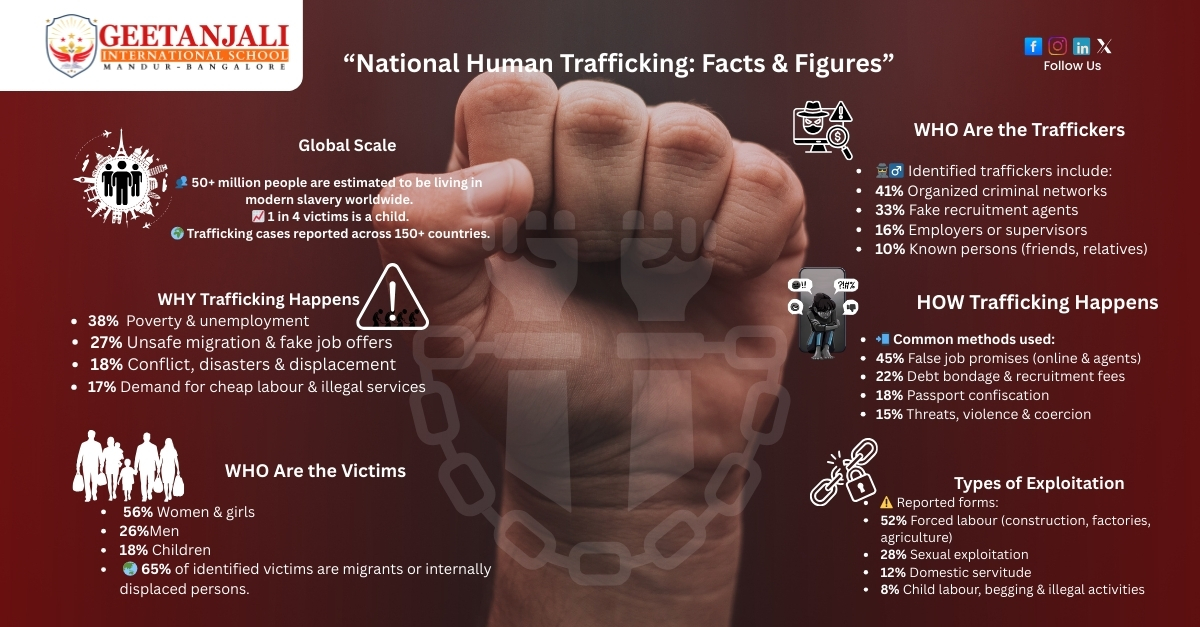
National Human Trafficking Awareness Day which takes place on January 11 serves as a reminder that people need to understand and protect themselves through their relationships with others especially when it comes to protecting children and young learners. The school community uses this day to provide students with safe and suitable educational experiences that teach them self-protection skills for actual life situations.
At Geetanjali International School in Mandur Bangalore the school teaches students about awareness through responsible and sensitive methods which create a safe environment that helps students to understand things better.
Human Trafficking: Educating Students for Awareness and Protection
Drug & Alcohol Hazards
- Drug addiction reduces one’s ability to make rational decisions.
- Drug traffickers amass control over their victims by using drugs.
- The victim experiences risky behaviors and may therefore be subject to exploitative circumstances which exacerbate the risk of addiction.
Online Photo Abuse
- The sharing of personal photographs may subject the person to blackmail (sextortion).
- This causes psychological stress and anxiety (emotional trauma and fear).
- Blackmail may drive a victim to engage in an exploitative relationship.
Connection to Human Trafficking
- Traffickers will often use addiction, fear, and online grooming to entrap youth.
- Targeted individuals will experience vulnerability and risk for either forced labor or sexual exploitation/abuse of minors.
Staying Safe
- Do not use drugs and/or alcohol.
- Do not share your photos with anyone.
- If you see something suspicious about someone you know, tell a trusted adult immediately!
Where Risks Begin: Understanding Unsafe Situations for Students
Unsafe situations begin from common locations which include both online spaces and physical areas whenever people misuse trust or violate personal space boundaries. Students encounter risks through various digital platforms which include social media sites and online gaming and messaging applications and through public spaces where strangers approach them with assistance and gifts and job offers.
Students receive training about personal data protection while learning to trust their instincts and handle situations which make them feel uncomfortable. The students should contact their parents or teachers whenever they experience something which makes them feel uncomfortable.
Learning Safety Through School-Based Activities on National Human Trafficking Awareness Day
Geetanjali International School provides useful student-centered activities which teach students the value of personal safety. The following activities which students will experience through their program include:
- The teachers will lead classroom sessions to teach students about the topic.
- Students will create posters and write slogans for their projects.
- Younger students will learn through storytelling and role-play activities.
- Older students will develop their skills through group discussions and presentations.
- The school assemblies will address both child safety and child protection rights.
The activities create opportunities for people to take part in activities which lead to positive experiences of learning through their study of work.
Building Trust Through Education
Creating awareness about human trafficking is not just about information—it is about building trust, confidence, and responsibility. When students feel supported by teachers and parents, they are better prepared to face real-life situations with awareness and caution.
As one of the top IGCSE curriculum schools in Bangalore, Geetanjali International School, Mandur, Bangalore remains committed to holistic education that prioritizes student safety, well-being, and social awareness.
FAQ’s
- What is human trafficking?
It is the illegal exploitation of people through force, fraud, or coercion - What online habits can keep students safe?
Avoid sharing personal details, photos, or location publicly. - How can schools help prevent human trafficking?
By educating students about safety, online awareness, and responsible behavior.