
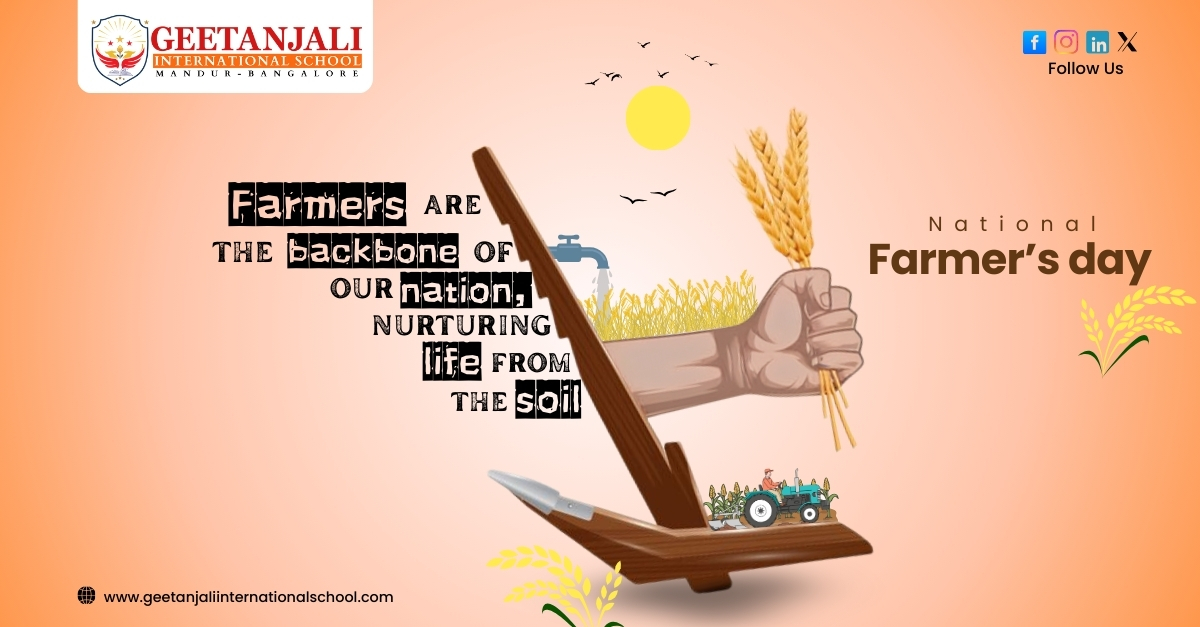
National Farmers’ Day on December 23 serves as an important educational event which teaches students about the fundamental agricultural role farmers perform in daily life and the process of building a prosperous nation. The day also marks the birth anniversary of Chaudhary Charan Singh, the 5th Prime Minister of India, who dedicated his life to safeguarding farmers’ rights and strengthening rural India. Students study his vision together with agricultural importance because this knowledge helps them understand food security issues and sustainability practices which support their development of respect for those who provide their meals.

Understanding Farmers Through Real-Life Facts
Farming helps students see how closely human life is connected to agriculture. In India, millions of families depend on farming for their livelihood, even as floods, heavy rains, and climate change make agriculture increasingly difficult. Learning these facts helps students value farmers’ hard work and the food they eat every day.
Government Schemes for Farmers: What Students Learn From Them
| PM-Kisan | Teaches how the government supports farmers’ income |
| Crop Insurance (PMFBY) | Helps students understand protection from crop loss due to natural disasters. |
| Kisan Credit Card | Shows how farmers get financial support for farming needs. |
| Soil Health Card | Creates awareness about soil care and sustainable farming |
| PM-KUSUM | Introduces eco-friendly farming using solar energy. |
| Irrigation Schemes | Highlights the importance of water conservation |
| Agriculture Infrastructure Fund | Explains how storage reduces food wastage. |
| MSP Policy | Helps students learn about fair pricing for farmers. |
Activities at Geetanjali International School, Mandur, Bangalore Regarding National Farmers’ Day
Geetanjali International School in Mandur Bangalore currently stands as one of the leading best IGCSE curriculum schools in Bangalore The school organized engaging activities which helped students develop their respect for farmers and agricultural practices.
- The classroom conducts discussions about farmers and their methods of producing food.
- Students participate in art activities which include creating posters.
- Students create short essays and stories and speeches.
- Students present their speeches during school assembly events.
- The organization implements environmental projects through its plantation drives and gardening programs and sustainable agricultural initiatives.
What National Farmers’ Day Teaches Students
The observance of National Farmers’ Day enables students to learn about farming through practical experiences which connect their classroom studies to authentic agricultural work. The students learn about food production origins and the difficulties farmers encounter due to climate change and natural disasters and the necessity of government support systems through their participation in discussions and activities and awareness programs. The learning experience develops students’ empathy and responsibility and respect for farmers while teaching them to value food and minimize waste and protect the environment through sustainable daily practices.
FAQs: National Farmers’ Day
Q1 Why is National Farmers’ Day important?
A1. It teaches students to respect farmers and understand their role in feeding the nation.
Q2. What do students learn from government schemes for farmers?
A2. They learn about income support, crop insurance, loans, soil care, irrigation, and eco-friendly farming.
Q3. How many people depend on agriculture in India?
A3. Around 40–45% of India’s population relies directly or indirectly on farming.